Tuesday, January 17, 2006

Annuity For Retirement Planning


Annuity

The term annuity, in current use in the insurance industry, refers to two very different types of legal contracts with very different purposes. Traditionally, for at least four hundred years, the term annuity referred to what is more correctly called today an immediate annuity. This is an insurance policy which makes a series of either level or fluctuating payments, paid out over a fixed number of years or during the lifetime(s) of one or two individuals, or in any combination of lifetime plus period certain guarantees. The overarching characteristic of the immediate annuity is that it is a vehicle for distributing savings. A common use for an immediate annuity might be to provide a pension income to a person who is about to retire.

The second usage for the term annuity came into its own during the 1970s. This contract is more correctly referred to as a deferred annuity and is chiefly a vehicle for accumulating savings. Note, this is different from the immediate and is the cause of much confusion when people discuss annuities without carefully defining which type of annuity they have in mind.

Under the heading of deferred annuities are contracts which may be similar to bank certificates of deposit (CD) in that they offer the buyer a safe interest rate of return on their money, or to stock index funds or other stock funds, where the growth of the account is dependent upon the performance of the market. All varieties of deferred annuities have one thing in common: any increase in account values is not taxed until those gains are withdrawn. This is also known as tax-deferred growth.

To complete the definitions here, a deferred annuity which grows by interest rate earnings alone is correctly called a fixed deferred annuity. A deferred annuity that permits allocations to stock or bond funds and for which the account value is not guaranteed to stay above the initial amount invested is correctly called a variable annuity. In the last ten years a new category of deferred annuities have emerged, called equity indexed annuities (EIAs). These policies are a hybrid of the two types of deferred annuities just described. The EIA offers a guarantee that the account value will never drop below the initial amount invested while also offering a chance to participate in the upside potential of any increase in the value of a major stock index, such as the S&P500 or Dow Jones Industrial Average.

By law an annuity contract can only be "manufactured" by an insurance company. They are distributed by, and available for purchase from, duly licensed bank, stock brokerage, and insurance company representatives. Some annuities may also be purchased directly from the "manufacturer," i.e., the insurance company writing the contract.

In a typical immediate annuity contract, an individual would pay a lump sum or a series of payments (called premiums) to an insurance company, and in return receive a fixed income payable for the rest of their life. The exact terms of an annuity product are drawn up in legal terms in a contract. We should mention that the term "anuity" is also used in finance theory to refer to any stream of fixed payments over a specified period of time. This usage is most commonly seen in academic discussions of finance, usually in connection with the valuation of the stream of payments, taking into account time value of money concepts.

By Annuity Info Center

http://annuity.gadget-info.com/

Planning For Retirement


Jump Start Your Retirement Plans

Step 1: Imagine your retirement
Step 2: Know where you stand
Step 3: Learn the basics
Step 4: Decide on a solution
Step 5: Talk to a financial professional

Are your pleasant daydreams about retirement ever harpooned by this panicky thought: What if I outlive my money? Well, don't sweat it. The most important element of investing — time — is something you still have. Here are five steps to making those panicky thoughts about retirement go away.

Step 1: Imagine your retirement Do you want to maintain your current life-style? A little simpler? A lot more grand? When you have a clear picture in your head about how you want your retirement to be, imagine the price tag attached to it. The Surprising Cost of Leisure ActivitiesWhat's the price tag on having fun in your retirement?What will my expenses be after I retire?

Step 2: Know where you standNow that you have an idea of what your expenses will be, you may be wondering how to know if you’ll have enough money to cover those expenses. Plan a Saturday afternoon where you can do what you have to do — get all the pertinent information together. Start with what you have now. Are your current savings invested properly, given the amount of time you have before retirement? Your Retirement Income Sources How Long Will My Money Last? Closing the Retirement Income "Gap" Am I saving enough? What can I change?

Step 3: Learn the basicsYou might know about mutual funds, but do you know how annuities work? What other retirement solutions are available to you? For instance, if your company matches your 401(k) contributions, what’s that worth to your retirement income? Understanding all your options can help you make the best choices.A Quick Guide to Investing Fundamentals The Advantages of Early-Start Investing Late-Start Investing: How to Catch Up

Step 4: Decide on a solutionNow it's time to fix your sights on your future savings. It doesn't matter how much or little you have to work with — what matters is that you get started now. Coming Up With the Cash to Invest Start Investing

Step 5: Talk to a financial professional
Steps 2-4 become a whole lot easier when you've got a financial professional on your side. It will cost you is some time — but then, you already know you have that going for you.


By Allstate.com

http://www.allstate.com/Finance/RetirementPlanning

Monday, January 16, 2006

Ronnie Coleman Beating Arnold Schwarzenegger's Record of 7 times Mr. Olympia

Interview With Ronnie Coleman before He Became The Greatest Bodybuilder In History.

March 6th, 2001 - Hello once again friends. Today I have the honor of interviewing the best of the best! He is "simply the best" that bodybuilding can offer today. He wrote history in 1998 when he won the Mr. Olympia, even though the previous year he was just 9th! (He became the first Mr. Olympia that came from so far behind.)

He recently wrote history again, when he became the first bodybuilder to win the Mr. Olympia and the Arnold classic in the same year! For all the people that love this sport he is undoubtedly "number 1" in our eyes. For baskeball fans their favorite is Michael Jordan. For tennis fans their favorite is Andre Agassi. But for bodybuilding fans his name is RONNIE COLEMAN!

Ronnie was introduced to competitive bodybuilding by Brian Dobson, the owner of the Metro Flex Gym in Arlington. He won the heavyweight and overall title in his first bodybuilding contest, Mr. Texas, in April 1990. Ronnie graduated from Grambling State College with a degree in Accounting.

He recently ended his 12-year police career, in order to not miss opportunities to compete and fly to bodybuilding appearances. He will remain a reserve officer with the department, working two days a month.


RONNIE COLEMAN'S INTERVIEW!

1. Q. Ronnie, the biggest dream of a competitive bodybuilder is to win the Mr. Olympia title, and that's something that you have already done 3 consecutive times. Now, since you are just the 10th person in Mr. Olympia history to fulfill this dream, is there something that you still want to accomplish? Maybe to break Lee Haney's record?

R.C. I just want to be the best bodybuilder that I can be as long as I can be. If it includes breaking Lee Haney's record then that is something I would cherish more than anything in the world.

2. Q. You will compete in the Arnold Classic in a few days. If you win, you will be the first bodybuilder in history to take 1st place in both, the Mr.Olympia and the the Arnold Classic. What was the reason for this kind of decision? Was it to accomplish something that no ex-Mr. Olympia has done in the past, or is it something else? (This interview was taken few days before the Arnold Classic. He Won!)

R.C. Yes that is the main reason why I'm doing this, I'm also trying to bring as much publicity to bodybuilding as I can. I want this sport to be more recognized than it currently is recognized. I too would love to get more recognition as the world's greatest bodybuilder and be someone to look up to as a role model for young kids.

3. Q. A Mr. Olympia should train very hard, eat many times per day, recuperate adequately, and use cutting edge supplements. What supplements do you currently trust and use?
R.C. I use a variety of Weider supplements, I take Zinc, Magnesium,
Multimineral and all of these are by the Schiff line. I take ZMA, Vitamin C-1000mg. Vitamin E-400IU, Weider Dynamic Muscle Builder, Creatine ATP by Weider, American Bodybuilding Turbo Tea, Speed Stack and my favorite to take everyday is Pain Free by Schiff recently named Move Free.

4. Q. Let's turn back the time and go to the year 1992. In your first Mr. Olympia that was held in Helsinki, you got just 16th place. My question is how easy or how difficult was it for you at that time to believe that you will get the Mr. Olympia some time in the future?


R.C. I never in a million years believed I would become Mr. Olympia. I was just competing to have fun and that was my only intentions back then. But if the oppurtunity came for me to make money, I would be more than happy to do that, but I never cared about becoming Mr. Olympia because I didn't think I had what it took to become Mr. Olympia.

5. Q. This is my last question for you Ronnie, and it's quite "hypothetical" but I believe it is a good one. Let's say that it would be possible to have a bodybuilding contest where the only competitors would be you, Arnold Schwarzenegger, Lee Haney, and Dorian Yates, and all of you in their prime condition. Who do you believe would win?

R.C. Come on now, this is the age of Ronnie Coleman who else would win... but I couldn't have beat them in their hey days.

By John Stamatopoulos

http://www.bodybuilding.com/fun/rcinter.htm

How Can We Strengthen Children's Self-Esteem?


Strengthening Your Child's Self-Esteem

Most parents want their young children to have a healthy sense of self-esteem. That desire can also be seen in education--schools around the country include self-esteem among their goals. Many observers believe that low self-esteem lies at the bottom of many of society's problems.
Even though self-esteem has been studied for more than 100 years, specialists and educators continue to debate its precise nature and development. Nevertheless, they generally agree that parents and other adults who are important to children play a major role in laying a solid foundation for a child's development.

What Is Self-Esteem?

When parents and teachers of young children talk about the need for good self-esteem, they usually mean that children should have "good feelings" about themselves. With young children, self-esteem refers to the extent to which they expect to be accepted and valued by the adults and peers who are important to them.

Children with a healthy sense of self-esteem feel that the important adults in their lives accept them, care about them, and would go out of their way to ensure that they are safe and well. They feel that those adults would be upset if anything happened to them and would miss them if they were separated. Children with low self-esteem, on the other hand, feel that the important adults and peers in their lives do not accept them, do not care about them very much, and would not go out of their way to ensure their safety and well-being.

During their early years, young children's self-esteem is based largely on their perceptions of how the important adults in their lives judge them. The extent to which children believe they have the characteristics valued by the important adults and peers in their lives figures greatly in the development of self-esteem. For example, in families and communities that value athletic ability highly, children who excel in athletics are likely to have a high level of self-esteem, whereas children who are less athletic or who are criticized as being physically inept or clumsy are likely to suffer from low self-esteem.

Families, communities, and ethnic and cultural groups vary in the criteria on which self-esteem is based. For example, some groups may emphasize physical appearance, and some may evaluate boys and girls differently. Stereotyping, prejudice, and discrimination are also factors that may contribute to low self-esteem among children.

How Can We Help Children Develop a Healthy Sense of Self-Esteem?

The foundations of self-esteem are laid early in life when infants develop attachments with the adults who are responsible for them. When adults readily respond to their cries and smiles, babies learn to feel loved and valued. Children come to feel loved and accepted by being loved and accepted by people they look up to. As young children learn to trust their parents and others who care for them to satisfy their basic needs, they gradually feel wanted, valued, and loved.

Self-esteem is also related to children's feelings of belonging to a group and being able to adequately function in their group. When toddlers become preschoolers, for example, they are expected to control their impulses and adopt the rules of the family and community in which they are growing. Successfully adjusting to these groups helps to strengthen feelings of belonging to them.

One point to make is that young children are unlikely to have their self-esteem strengthened from excessive praise or flattery. On the contrary, it may raise some doubts in children; many children can see through flattery and may even dismiss an adult who heaps on praise as a poor source of support--one who is not very believable.

The following points may be helpful in strengthening and supporting a healthy sense of self-esteem in your child:

As they grow, children become increasingly sensitive to the evaluations of their peers. You and your child's teachers can help your child learn to build healthy relationships with his or her peers.

When children develop stronger ties with their peers in school or around the neighborhood, they may begin to evaluate themselves differently from the way they were taught at home. You can help your child by being clear about your own values and keeping the lines of communication open about experiences outside the home.

Children do not acquire self-esteem at once nor do they always feel good about themselves in every situation. A child may feel self-confident and accepted at home but not around the neighborhood or in a preschool class. Furthermore, as children interact with their peers or learn to function in school or some other place, they may feel accepted and liked one moment and feel different the next. You can help in these instances by reassuring your child that you support and accept him or her even while others do not.

A child's sense of self-worth is more likely to deepen when adults respond to the child's interests and efforts with appreciation rather than just praise. For example, if your child shows interest in something you are doing, you might include the child in the activity. Or if the child shows interest in an animal in the garden, you might help the child find more information about it. In this way, you respond positively to your child's interest by treating it seriously. Flattery and praise, on the contrary, distract children from the topics they are interested in. Children may develop a habit of showing interest in a topic just to receive flattery.

Young children are more likely to benefit from tasks and activities that offer a real challenge than from those that are merely frivolous or fun. For example, you can involve your child in chores around the house, such as preparing meals or caring for pets, that stretch his or her abilities and give your child a sense of accomplishment.

Self-esteem is most likely to be fostered when children are esteemed by the adults who are important to them. To esteem children means to treat them respectfully, ask their views and opinions, take their views and opinions seriously, and give them meaningful and realistic feedback.

You can help your child develop and maintain healthy self-esteem by helping him or her cope with defeats, rather than emphasizing constant successes and triumphs. During times of disappointment or crisis, your child's weakened self-esteem can be strengthened when you let the child know that your love and support remain unchanged. When the crisis has passed, you can help your child reflect on what went wrong. The next time a crisis occurs, your child can use the knowledge gained from overcoming past difficulties to help cope with a new crisis. A child's sense of self-worth and self-confidence is not likely to deepen when adults deny that life has its ups and downs.

By Lilian Katz

http://www.kidsource.com/kidsource/

What Is A Sample Of Aggressive Portfolio Consists Of


Aggressive Portfolio

Composed entirely of stocks, the Moderately Aggressive Portfolio is the most aggressive of the five asset-allocation models. Sample Aggressive Portfolio 20% Strategic Value Fund 15% Stock Market Index Fund 20% Growth Fund 20% International Developed Countries Fund 20% Small Company Fund 5% International Emerging Markets Fund.


A sample of aggressive portfolio consists of 100% stocks. This model is for investors who are aggressive in their investment objective to achieve high return.

By Mutual of Omaha Insurance Company

http://www.mutualofomaha.com/

What A Sample Of Moderately Aggressive Portfolio Consists Of


Moderately Aggressive Portfolio

The Moderately Aggressive Portfolio invests most of its assets in stocks while providing a certain level of security through some conservative investments. Sample Moderately Aggressive Portfolio 20% Bond Index Fund 15% Strategic Value Fund 15% Stock Market Index Fund 15% Growth Fund 15% International Developed Countries Fund 15% Small Company Fund 5% International Emerging Markets Fund.

A sample of a moderately aggressive portfoilo consists of 80% stocks and 20% bonds. This model is suitable for aggressive investors who are looking for higher return in the long run. However, this model can be volatile.

By Mutual of Omaha Insurance Company

http://www.mutualofomaha.com/

What Is A Sample Of Moderate Portfolio Consists Of


Moderate Portfolio

The Moderate Portfolio is a “middle of the road mix of conservative investments and stocks. Sample Moderate Portfolio 40% Bond Index Fund 10% Strategic Value Fund 15% Stock Market Index Fund 10% Growth Fund 15% International Developed Countries Fund 10% Small Company Fund.

A sample of a moderate portfolio consists of 60% stocks and 40% bonds. For investors who can tolerate a bit more risks, this model will be able to help them achieve a better return in the long run.

By Mutual of Omaha Insurance Company

http://www.mutualofomaha.com/

What Is A Sample Of Conservative Portfolio Consists Of


Conservative Portfolio

The Conservative Portfolio looks to provide stability of income with minimal risk. Sample Conservative Portfolio 50% Stable Value Fund 30% Bond Index Fund 20% Stock Market Index Fund.

A sample of a conservative portfolio consists of 50% Fixed Income, 30% Bonds and 20% stocks. For investors who are not tolerance of risks, a conservative portfolio will meet that investment objective.

By Mutual of Omaha Insurance Company

http://www.mutualofomaha.com/

What Is A Sample Of Moderately Conservative Portfolio Consists Of


The Moderately Conservative Portfolio

The Moderately Conservative Portfolio invests most of its assets in conservative investments, while providing some exposure to the growth potential of stocks. Sample Moderately Conservative Portfolio 30% Stable Value Fund 30% Bond Index Fund 15% Stock Market Index Fund 10% International Developed Countries Fund 5% Strategic Value Fund 5% Growth Fund 5% Small Company Fund.

This is just a sample of a moderately conservative portfolio for those investors who are not tolerance to very high risk. Of course, there are many combination but basically the portfolio consists 30% Fixed Income, 30% Bonds and 40% Stocks.

By Mutual of Omaha Insurance Company

http://www.mutualofomaha.com/

Sunday, January 15, 2006

Ernesto Osorio's Killer Recipe For A Lean, Mean, High Protein Barbeque Favorite


A Protein Packed Main Course for Building Mass

Chicken breast is a protein-packed starting point for the ideal meal.

Normally, when you think about building muscle, you think protein. Mass-building requires energy, through high carbohydrate intake. "To gain mass, you have to ensure you're getting enough protein to rebuild muscle tissue damaged through training.

By John Kelly

http://www.muscleandfitness.com/nutrition/recipes/5

Chocolate Goodness


Chocolate Can Be Good For Your Health

Possible benefits of eating chocolate.

Flavonoids, antioxidants.Chocolate is chock-full of flavonoids—naturally-occurring compounds found in the cacao plant, as well as in red wine, tea, fruits, and vegetables. Flavonoids may have potentially beneficial effects on cardiovascular health. They may also act as antioxidants, which are believed to prevent or delay certain damage to the body’s cells and tissues.


Good cholesterol.

Chocolate and cocoa butter contain two main saturated fats (palmitic and stearic acids) and one mono-unsaturated fat (oleic acid). Unlike other saturated fats, stearic acid is a neutral fat and does not appear to raise bad cholesterol (LDL). Oleic acid is the same type of fat in olive oil and may actually raise good cholesterol levels (HDL).

The feel good factor.

Chocolate contains small amounts of a chemical called phenylethylamine (PEA), which is a mild mood elevator. It’s the same chemical that our brain produces when we feel happy or in love. The mild rush we get from this substance may be why some people say they’re addicted to chocolate.

Chocolate in moderation.

Most chocolate consumed today is milk chocolate, which is high in saturated fat, sugar, and calories none of which qualify as heart-healthy so eat in moderation.A single bar of dark chocolate contains more than twice as many antioxidants as a bar of milk chocolate. Dark chocolate has fewer calories than milk chocolate.Milk chocolate is much higher in bad saturated fats and calories simply because it contains milk. Also, it contains fewer cocoa solids per ounce (and thus fewer antioxidants). It takes four cacao seeds to make one ounce of milk chocolate and 12 seeds to make one ounce of dark chocolate. Although milk chocolate does contain more calcium.

Minerals

Cocoa and chocolate provide a treasury of minerals. Often working in conjunction with vitamins, these are also indispensable for normal physical function. The most significant of the minerals are:

Calcium: 3 - 40% Mostly found in milk and white chocolate. Needed for the formation and maintenance of bones and teeth.Together with vitamin A, aids coagulation of blood in wounds. Plays a role in muscle function.

Magnesium: 6 - 60% The greatest concentrations are found in dark chocolate. Helps maintain a strong skeletal system.primarily active in the promotion of memory and brain function and in preventing depression.

Copper: 0 - 60% Mostly found in dark chocolate and, to a lesser extent, in milk chocolate. Probably has a role in countering cardiovascular disease.

Iron: 2 - 35% Mostly found in dark chocolate. Active in the transport of oxygen to all body tissues.

Phosphorus: 25 - 35%Only in milk and dark chocolate. Involved in the maintenance of a strong skeletal system. Has a role in the utilization of energy arising from food.

Zinc: 7 - 17% The highest concentrations are found in dark chocolate. Important in the take-up of nutritional elements frommacro-nutrients. Involved in cell growth and the repair of tissue in the human body.

Manganese: 0 - 100% The highest concentrations are found in dark chocolate and, to a lesser extent, in milk chocolate. Aids the functioning of the nervous system.


By Chocolate Design U.K.

http://www.chocolatenovelties.co.uk/chocolate_goodness.htm

Important Facts About Aromatherapy


What is Aromatherapy?

The last twenty years have seen an increase in complementary healing methods and the use of naturally derived products such as essential oils. Aromatherapy, often considered a fringe practice, has now become so accepted and respected that it is on offer to many hospital patients as part of their allopathic treatment. Manufacturers of health products, cosmetics and perfumes are acknowledging the value of essential oils to enhance the quality of their products and home use of oils has risen phenomenally. Current scientific research into the chemistry and medicinal use of certain oils has both confirmed and clarified their healing potential. Cultivation methods, location and climate, precise knowledge of species, extraction and distilling techniques have all had an enormous influence on the resulting oils available to the public, and all this allows for a more pure and therapeutic product.

When we peel an orange, smell a rose or crush a stalk of rosemary, we become aware of the unique scent of the plant. It is the innermost essential oils or “lifeblood” that give them their specific smell and flavor; in profusion as with the orange or in tiny quantities as with a rose. The tiny droplets of oil in the cells of the outer peel of the orange are very volatile and they evaporate easily, infusing the surrounding air with their well known smell. In contrast, the aromatic content of a rose is very small indeed; it will take one ton of petals to produce only 300g of rose oil, the main reason why pure essential rose oil is high priced. Essential oils certainly both attract or repel different insects or animals and are important in the transpiration and life cycle of the plant, rather like a hormone. Oils are found in all parts of a plant; seeds, bark, leaves, root, flowers and resin or gum. They have been used for thousands of years as incense, perfumes, cosmetics, medicines and for cooking. They were used in sacred ceremonials of many cultures; either rubbed on the body, burned or sprinkled for purification and protection and to enhance spiritual or psychic awareness. We still see this today with the burning of frankincense and myrrh during the Catholic mass. Probably the most famous associations concerning the first aromatic materials are those used by the ancient Egyptians. Papyrus scrolls dating back to 2800 BC describe the use of many medicinal herbs, fine oils, incense and perfumes; gums and oils like cedar and myrrh were used to embalm bodies. Natural aromatics made up one of the earliest trade items of the ancient world, and were considered rare and treasured items.

Marguerite Maury (1895 – 1968) was an intelligent and dedicated woman who did a lot to establish the validity of the efficacy of essential oils, and set up the first aromatherapy clinics in Paris, Britain and Switzerland. She was awarded two international prizes in 1962 and 1967 for studies on the use of essential oils in cosmetology and focused mainly on the rejuvenating qualities of oils. The word “aromatherapy” was first used in 1928 by Rene-Maurice Gattefosse who was a French chemist employed in the family perfumery. One day while working he burned his hand and discovered by accident that lavender oil healed his hand rapidly with no scars. He then found that many essential oils were more effective in their totality than their synthetic substitutes or their isolated active ingredients. In 1964, Dr Jean Valnet, a French doctor and scientist, used essential oils as part of a program successfully treating specific medical and psychiatric problems.

The word aromatherapy is somewhat misleading, as it suggests that it is healing that only works using the sense of smell and on the emotions. However, aside from the scent, each oil has a combination of constituents that interacts with the chemistry of the body which then affects particular organs or systems as a whole. When oils are used externally as with a massage oil, they are easily absorbed by the skin (at different rates depending on the type of oil) and sent around the body. If you rub a clove of garlic on the sole of the foot, it can be smelled on the breath shortly after. Essential oils have three modes of action as to how they interact with the human body. Firstly, the pharmacological effect is related to the chemical changes that occur when an oil enters the bloodstream and reacts with hormones and enzymes; secondly, the physiological effect is related to the way that an oil affects the system of the body such as being sedated or stimulated and so on; and thirdly, the psychological effect which happens when an oil is inhaled and causes a response to the smell.

Aromatherapy is the therapeutic use of essential oils. It is a natural approach to healing and an alternative to the current emphasis on prescription and over the counter medications.

Essential oils are recognized by their antibacterial, antioxidant, anti fungal, antiviral and anti-inflammatory properties. They are effective in the treatment of many infections and respiratory conditions. They can improve immune function and response and help balance the nervous system.

While "aromatherapy" candles, bath gels and lower grade oils can have a pleasant fragrance and we can enjoy using them, very few (if any) will have any true therapeutic value or effect on the body.

True therapeutic essential oils are of a much higher quality than the commercial grade oils used by perfume companies and the fragrance industry. Only raw, pure, therapeutic grade essential oils, that have been grown, harvested and distilled in the right environment specifically for this purpose, will have the healing properties we desire in an essential oil.

Re-distillation is routinely performed by perfume and fragrance industry to get a more favorable scent, but this adversely affects the therapeutic quality of the oils.

Because pure, therapeutic essential oils do have a physiological, a psychological and a pharmacological effect on us, it is important to be aware of and to follow responsible cautions when using therapeutic essential oils.

By artofaromatherapy.com

http://artofaromatherapy.com/facts.htm

Using Good Debt To Earn Her 3 Millions In Three Months


Her High Financial Quotient & Enterprising Mindset Has Earned Her The Titile Of " The Card Goddess" In TAIPEI

Story of how she borrow money from her credit card to make 3 million in 3 months.

Investment Is All About Trust


Choose An Investment That You Admire and Trust The People Managing It.

Good Debt and Bad Debt


MAKING MONEY WORK

There can be good debt as well as bad debt. Good debt can be described as debt that helps you build equity or increase your net worth. For example, education loans usually are considered good debt because in the long run more education generally translates into higher earning power. Most people borrow money for a mortgage to get a home—if the home purchase was a wise investment that increases in value and adds to your net worth, then it would be considered good debt. Another example of good debt might be loans to run a small business—for example, if you borrow money at 7 percent and use that money to make a 15 percent or 20 percent return, then it would be considered good debt because you are using the loan to increase your net worth. Good debt includes loans that help to build your financial future.

On the other hand, bad debts are the ones that negatively impact your financial future. Bad debt might be described as obligations that last longer than the purchase item and ones that have no return toward increasing your net worth. Before making a purchase via a loan, ask yourself is this good debt or bad debt—will the debt help to increase my net worth or will it decrease my net worth? Avoid as much bad debt as possible. The Financial Planning Association suggests that total debt should not exceed 10–15 percent of your take-home pay—excluding mortgages. Many credit experts recommend that debt should not exceed 25 percent of disposable income. Over indebtedness can push you to the maximum to repay your debt while still trying to maintain daily living expenses. A sudden unexpected event such as a job downsizing, divorce, a death in the family, an uninsured accident, theft, a large tax bill, or a major medical expense can have tragic results to your finances and result in a credit crisis. A major unexpected event combined with insufficient savings and insurance can easily result in a credit crisis. Assuming credit loans is something you want to avoid if at all possible. Few things are worth borrowing for. Avoid going into debt for rewards such as vacations or fancy restaurant meals; save for them and pay cash. Borrow as little money as possible and at the lowest interest rate possible.

Most debt can be avoided if you take action to live within your income. Consumer Credit Counseling Services stated that the number one cause of money problems with their nationwide clients was poor money management including impulsive spending. Practice delayed gratification—earn the money before you spend it. Save for purchases if at all possible until you can pay cash or use debit cards for them. When you borrow money, you pay interest plus the principal borrowed, so items purchased end up costing you much more than the original price. Practicing delayed gratification until you can pay cash saves you the added cost of the item and has less negative impact on your future net worth. Studies indicate that consumers generally spend about 25 percent less when they pay cash for items. This is due to the savings on interest charges and the fact that you waste less money on impulse purchases due to the temptation and convenience of credit cards. Many impulse purchases are for items you do not even need.


Forty percent of people pay off credit card purchases in full every month—the other 60 percent would benefit from making changes in their spending habits. If you purchase only what you can pay cash for, chances are you are in control of your financial life. You may be overextended if you cannot pay all of your debt—excluding mortgage—in 18 to 24 months. If you pay only the minimum amount due on your outstanding credit cards month after month, you might stay in debt indefinitely since most of the payment goes toward interest. You definitely have a credit problem if you cannot pay all of your monthly minimums. You should eliminate nonproductive, expensive debts as soon as possible.

Learning to manage your debts will make a different to your financial future.


By Bill G. Page

http://www.cbn.com/finance/MMW082505.asp

Use The Diabetic Food Pyramid To Plan Your Diet


Using the Diabetes Food Pyramid

The Diabetes Food Pyramid divides food into six groups. These groups or sections on the pyramid vary in size. The largest group -- grains, beans, and starchy vegetables -- is on the bottom. This means that you should eat more servings of grains, beans, and starchy vegetables than of any of the other foods. The smallest group -- fats, sweets, and alcohol -- is at the top of the pyramid. This tells you to eat very few servings from these food groups.

The Diabetes Pyramid gives a range of servings. If you follow the minimum number of servings in each group, you would eat about 1600 calories and if you eat at the upper end of the range, it would be about 2800 calories. Most women, would eat at the lower end of the range and many men would eat in the middle to high end of the range if they are very active. The exact number of servings you need depends on your diabetes goals, calorie and nutrition needs, your lifestyle, and the foods you like to eat. Divide the number of servings you should eat among the meals and snacks you eat each day.

The Diabetes Food Pyramid is a little different than the USDA Food Guide Pyramid because it groups foods based on their carbohydrate and protein content instead of their classification as a food. To have about the same carbohydrate content in each serving, the portion sizes are a little different too. For example: you will find potatoes and other starchy vegetables in the grains, beans and starchy vegetables group instead of the vegetables group. Cheese is in the meat group instead of the milk group. A serving of pasta or rice is 1/3 cup in the Diabetes Food Pyramid and ½ cup in the USDA pyramid. Fruit juice is ½ cup in the Diabetes Food Pyramid and ¾ cup in the USDA pyramid. This difference is to make the carbohydrate about the same in all the servings listed.

Following is a description of each group and the recommended range of servings of each group.

Grains and Starches

At the base of the pyramid are bread, cereal, rice, and pasta. These foods contain mostly carbohydrates. The foods in this group are made mostly of grains, such as wheat, rye, and oats. Starchy vegetables like potatoes, peas, and corn also belong to this group, along with dry beans such as black eyed peas and pinto beans. Starchy vegetables and beans are in this group because they have about as much carbohydrate in one serving as a slice of bread. So, you should count them as carbohydrates for your meal plan.

Choose 6-11 servings per day. Remember, not many people would eat the maximum number of servings. Most people are toward the lower end of the range.

Serving sizes are:
1 slice of bread

¼ of a bagel (1 ounce)
½ an English muffin or pita bread1,
6 inch tortilla
¾ cup dry cereal½ cup cooked cereal½ cup potato, yam, peas, corn, or cooked beans
1 cup winter squash1/3 cup of rice or pasta

Vegetables

All vegetables are naturally low in fat and good choices to include often in your meals or have them as a low calorie snack. Vegetables are full of vitamins, minerals and fiber. This group includes spinach, chicory, sorrel, Swiss chard, broccoli, cabbage, bok choy, brussels sprouts, cauliflower, and kale, carrots, tomatoes, cucumbers, and lettuce. Starchy vegetables such as potatoes, corn, peas, and lima beans are counted in the starch and grain group for diabetes meal planning.

Choose at least 3-5 servings per day.

A serving is:
1 cup raw½ cup cooked


Fruit

The next layer of the pyramid is fruits, which also contain carbohydrates. They have plenty of vitamins, minerals, and fiber. This group includes blackberries, cantaloupe, strawberries, oranges, apples, bananas, peaches, pears, apricots, and grapes.

Choose 2-4 servings per day

A serving is:
½ cup canned fruit

1 small fresh fruit
2 tbs dried fruit
1 cup of melon or raspberries
1 ¼ cup of whole strawberries

Milk

Milk products contain a lot of protein and calcium as well as many other vitamins. Choose non-fat or low-fat dairy products for the great taste and nutrition without the saturated fat.

Choose 2-3 servings per day

A serving is:
1 cup non-fat or low-fat milk

1 cup of yogurt

Meat and Meat Substitutes

The meat group includes beef, chicken, turkey, fish, eggs, tofu, dried beans, cheese, cottage cheese and peanut butter. Meat and meat substitutes are great sources of protein and many vitamins and minerals.

Choose from lean meats, poultry and fish and cut all the visible fat off meat. Keep your portion sizes small. Three ounces is about the size of a deck of cards. You only need 4-6 ounces for the whole day.

Choose 4-6 oz per day divided between meals

Equal to 1 oz of meat:
¼ cup cottage cheese
1 egg
1 Tbsp peanut butter
½ cup tofu

Fats, Sweets, and Alcohol

Things like potato chips, candy, cookies, cakes, crackers, and fried foods contain a lot of fat or sugar. They aren't as nutritious as vegetables or grains. Keep your servings small and save them for a special treat!

Serving sizes include:

½ cup ice cream
1 small cupcake or muffin
2 small cookies

The Diabetes Food Pyramid makes it easier to remember what to eat. For a healthy meal plan that is based on your individual needs, you should work with a registered dietitian (RD) with expertise in diabetes management.

By Flourish Wellness

http://www.flourishdiabetes.com/understanding.asp

Reduce Your Investment Risks By Using Dollar Cost Averaging Technique


Concept Of Dollar Cost Averaging

Another widely followed technique to make stock investing a strategical task is dollar cost averaging. Dollar cost averaging means making periodic investments of the same amount of money in the same stock regardless whether the price is declining or ascending. The same dollar amount of investment will be made in the same security on the 15th of every month, or on the first day of every quarter or whatever interval is selected. The investment must be devoid of any consideration of the current stock price, if the investor wishes to maintain a program of dollar cost averaging. The idea behind this investing strategy is that by investing the same amount each month over a period of years, you buy more shares at market lows and fewer shares at market highs. As time goes by, the cost of stock shares you add to your portfolio balance out to an average price. This cuts down on the risk that you invest a lump sum at market highs and helps you to continue buying at market lows when others are selling and missing out on potential future gains.


This type of investing strategy has several key advantages. First, it prevents procrastination. Some investors have a hard time getting started. They may know they should be investing, but they never manage to get into the stock market. Once started, dollar-cost averaging can be an easy way to commit to regular investing. Second, dollar-cost averaging helps you participate in the stock market regardless of current conditions. Thirdly, this investing strategy minimizes remorse associated with getting in or out of the market at the wrong time. Even the most experienced investor probably feels a tinge of regret when an investment proves to be ill timed. Worse, such regret may cause you to disrupt your investing strategy in an attempt to make up for your setback. Dollar-cost averaging can minimize this regret because you make multiple previously scheduled investments, with none of them being particularly large.
Dollar cost averaging does not assure a profit and does not protect against loss in declining stock markets. This type of plan involves continuous investment in securities regardless of fluctuating price levels, so investors should consider their financial ability to continue their purchases through periods of both high and low price levels. Historically, dollar-cost averaging over the long term has been a wise, low-cost and potentially profitable way to invest.


By RankUHigh.Com

http://www.stockmarketinvestinginfo.com/smi_dollarcostaveraging.html

Even Einstein Is Impressed By The Power Of Compound Interest

The Power of Compound Interest

How important is it to begin putting aside money for savings right now, as opposed to sometime later?

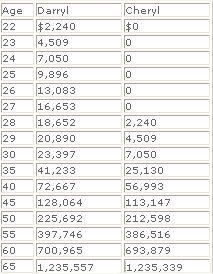
The following chart illustrates the effect of compound interest on savings over the course of 40-plus years. It shows that now is the time for saving.

The sooner you start to save, the greater the benefit of compound interest. Compound interest is the interest earned on reinvested interest, in addition to the original amount invested.

Here's an example: Two different individuals--Darryl and Cheryl, each 22 years old--have an extra $2,000 a year to invest or spend as they choose. Darryl opens an Individual Retirement Account (IRA) to start saving. Cheryl chooses to spend her $2,000.

In this example, Darryl's IRA earns 12% per year. Darryl saves $2,000 per year for six years, then never puts another cent into his IRA.

Cheryl spends her $2,000 per year for six years. After that time, she invests $2,000 per year until she is 65 years old. Cheryl earns the same 12% interest per year that Darryl does.
The chart below shows the value of Darryl's and Cheryl's respective IRAs, from the time they are 22 years old all the way to 65. Keep in mind, Darryl's total investment is $12,000 ($2,000 per year for the first six years), while Cheryl's is $74,000 ($2,000 per year for the last 37 years).


As you can see, with compound interest, the earlier you start saving, the greater the accumulated interest on your original investment. The important thing is to start saving your money. The best time to start saving is now--no matter how large or small the amount. It's never too late to start. Remember, today is the first day of the rest of your life, so get time on your side and plan for your future by starting to save--now.

By InCharge Education Foundation

http://www.mindyourfinances.com/money-management/savings/081104-04

Family Finances: Understand The Risks Of Every Investment

Understand Your Investment

Being successful with the family's money has less to do with having amazing investment skills than with understanding the categories of investments you have.
Each investment has trade-offs. As risk increases, so do your returns and vice versa. The trick of successful investing is to balance the two so that you earn more and lose less.

Perhaps the most effective New Year's resolution you can make is to understand basic investment categories. Then check the family's investments. Decide what's best for the future.

Investments typically fall into these groups.

Stocks. This is the riskiest category. When you buy stock, you are part owner of a company. Your greatest risk is that the company could go belly-up. Then the company's stock is worth nothing. Or, bad news about a company could send the stock price south.

By contrast, stocks have historically outperformed most other investments over the long term of 10 years or more. Stocks, as measured by the Standard & Poor's 500 stock market index, have averaged annual returns of 10 percent. But to earn this kind of return, you need to own stocks for at least a decade. Don't rely on stocks if you need money soon. You don't have enough time to make up any losses.

Be advised: Some stocks are less risky than others. For example, stocks that pay dividends are lower-risk than those that don't because you're earning periodic income that can help offset future losses. Utilities, which provide services most people can't live without, historically have been lower-risk.

Bonds. With a bond you're the lender. You get a guarantee from your borrower -- a company or government. You get paid interest and your principal is returned to you when the bond matures.

Most corporate bonds are backed by collateral -- assets of the company. Bonds are less risky than stocks because if your borrower goes belly-up, bondholders get paid before stockholders. But because bonds are lower-risk, they typically pay less. Bonds historically have averaged about 5 percent annually -- half the returns of stocks.

There is no free lunch with bonds. Bond prices move in opposite directions to interest rates. Sell your bonds when rates are rising, and you will lose money.

Also, a bond may be "called" prior to maturity. If rates drop substantially, your borrower may decide to return your principal, forcing you to reinvest at lower rates.

Treasury bonds, guaranteed by the U.S. government, are lower-risk than corporate bonds. Short-term bonds are lower-risk than long-term bonds because their prices are not apt to fluctuate as much if you must sell them.

Cash. This is the lowest-risk category. Cash is not money you put in a piggy bank. Rather, cash investments are short-term debt instruments such as CDs, U.S. Treasuries, corporate I.O.U.s, known as commercial paper, or money market mutual funds.

Cash investments historically have returned less than bonds or stocks -- about 3 percent annually. They are considered lower-risk because in such a short term, there isn't enough time to lose much. However, commercial paper, corporate I.O.U.s, are riskier than Treasury bills, which are backed by Uncle Sam. Bank CDs are slightly riskier than Treasury bills, but typically will pay a bit more.

Most other investments revolve around the above three categories. Mutual funds, for example, are professionally managed pools of investments, which may include any of the three groups.
Once you understand an investment's risk and the potential return, you can make some decisions based on your goals.

Perhaps, the easiest way to invest in stocks is to invest regularly in a well-managed stock mutual fund. You don't want to put all your money in stocks to make a quick killing if your roof is leaking and needs repair. But you don't want to have all your money in cash investments either. The return on your investment may not keep pace with increasing costs.
You may not wish to own 20-year bonds if you think you might need to sell them to meet a financial emergency. Despite their higher rates, you could take a beating if interest rates rise.
Struggling to pay rent? Cash investments are for you -- until you have managed to become a bit more financially secure.

Once you've figured out the proper mix of investment categories for your specific situation, it's time to start researching the best-managed in each category. Then, sit back, relax, and have a prosperous new year!

By Alan Lavine and Gail Liberman

http://www.post-gazette.com/pg/05003/436212.stm

Sylvester Stallone: Fitness's Renaissance Man

Still punching at 58, a screen legend returns to his boxing and training roots with a reality television show and a new line of supplements. In the peculiar world of Hollywood, typecast represents the ultimate irony.

Actors and actresses long for a role that will be embraced, a character that resonates with the public and transcends the realm of fiction and becomes a living, breathing part of the culture. Then, when such an epiphany is achieved, that same performer shuns the attention, longing to be seen outside that light. Yet for the man who created one of the most revered movie personas in history--a celluloid hero who arguably spearheaded the massive fitness revolution of the '80s--such is not the case.

In fact, Sylvester Stallone has unabashedly returned to the mantle of his greatest cinematic creation five times, and now, on the precipice of a sixth Rocky film, he's revisiting the spheres where his star shines brightest: boxing and fitness.

With The Contender, a reality TV series that chronicles aspiring pugilists as they vie for a $1 million payday, and InStone Nutrition, a line of supplements bearing his name and likeness, Stallone, now 58, returns to his roots, ready to once again inspire millions to follow in his muscular footsteps. To him, Rocky is not an albatross but a remarkable icon that even he can appreciate. The Rocky Factor

For the past 20-plus years, Stallone has continued to make films in the action genre, with hits such as First Blood, Demolition Man, Cliffhanger, Tango & Cash and his most recent box-office success, 2001's Driven.

While he also made some unfortunate forays into comedy--let's not forget Stop! Or My Mom Will Shoot--Stallone never turned his back on the hard-nosed, softhearted brawler from Philly. After 1976's Rocky earned a Best Picture Oscar, a one-in-a-million-shot if there ever was one, he returned to the franchise in 1979, 1982, 1985 and 1990.

Speaking from his Los Angeles home, Stallone is quick to acknowledge the reach of Balboa. Fans worship at the altar of Rocky as an entity that pushed them into the gym and changed their lives, and that suits the man who brought him into existence just fine.

"It's not me, it's more of a...Rocky philosophy that some of them have been affected by," he says, trying to put words to the phenomenon. "For instance, I went to the opening game of the Philadelphia Eagles' new stadium this past year. I came out for a moment just to wave to the crowd. When the entire stadium erupted, I realized they weren't erupting for Sylvester Stallone. Perish that thought. It's Rocky. [They see Rocky] as representative of their city. 'We don't give up. We put our head down and keep punching.' That's what I think I symbolize to people."
Coproducer of The Contender, Survivor's Mark Burnett certainly hopes to capture that Rocky mojo. He called Sly to bring him onboard for the show, which will make its debut on NBC in January. "I asked Burnett, 'Are you sure you don't want someone who's more of a boxing celebrity?'" Stallone recalls. "And he said, 'No, what we're trying to do is bring entertainment value, yes, but also tap into something that you'll be identified with for all your days.'"
Sly was intrigued by the prospect of creating a real-life Rocky scenario for one lucky fighter. He'll serve as a mentor who circulates among the athletes, while experts such as Sugar Ray Leonard work with the 16 contestants on the physical aspects of the sport. "This provides an interesting venue to take fiction and employ it in the world of reality," he says. "In other words, it gives a chance to people who have perhaps never had a break or have let opportunity slip through their fingers. This is about more than boxing; it's a kind of fantasy come true."


Walking The Walk

Concurrently, Stallone has immersed himself in a decidedly different project--launching a supplement company, InStone Nutrition. "InStone has been something I've thought about for 7-8 years," he says. "I've experimented so much with my body, training and diet-wise, coming up with different looks for movies. For instance, in Cliffhanger I had to develop more leg and shoulder power; in Rocky 3 I got down to 2.8 percent bodyfat; and of course Cop Land, where I lost all that definition and gained 40 pounds."

One key in turning his vision into reality was a hands-on approach. "I wanted to stand behind the product by saying, 'I am the guinea pig,'" he explains. "This isn't something that I'm just putting my name on. I think that would be quite a disappointment to people. I use the products, and I can safely say, everything is extraordinary. Each of these products is the best in the market in its particular niche."

Making appearances for The Contender and promoting InStone, Sly is holding steady at a chiseled 196 pounds, 4 to 7 percent bodyfat. Through the years, he's learned an important lesson about diet and training: Keep it simple. "I follow a high-protein diet: Anything with a face, that's what I eat, with something green next to it," he says. "Over the years, my biggest flaw was overtraining. In the gym six days a week, doing more sit-ups at night...my body was in a constant state of breakdown. Now I focus on a variety of exercises, working out three times a week for 90 minutes per session. I really feel good--much stronger than I've ever felt, actually. Something's working."

That something will be revealed in depth in the coming months, as he takes the lessons he's learned over the years and puts them to paper. "It'll be a retrospective of how I've trained," he says of a book he has in the works. "From the first time I changed my body for a role, going from 162 to around 200 to play the gang bully in [1974's] Lords of Flatbush, to Rocky, how all that was done--what worked, what didn't, the trials and tribulations. Hopefully the end result of my experimentation is that I make it easier for other people to transform themselves."

One More Round

While Stallone pursues his offscreen projects, looming on the horizon may be one final step into the ring for Rocky Balboa. The script has been written, but after some wrangling with MGM Studios, the project has yet to receive a green light. "It's being postponed for all the wrong reasons," Sly says. "Hopefully it will prevail."

Stallone sees elements of Rocky 6 playing out in the real-life fight to bring it to the big screen. "Rocky 6 is a story that deals with skepticism," he explains. "When we reach a certain age, society says, 'You've had your moment.' But a lot of people aren't ready to move on. They want to try something they've never done before or go back to something they haven't finished."
Sly pauses, perhaps reflecting on how the evolution of Rocky, in many ways mirrors his own growth as an actor and individual. "You may not have the speed, but you still want to run the race. Think of George Foreman winning the heavyweight title [at 45], or John Glenn going into space [at 77]...your pursuits are what keep you vital. Society may say step aside and let youth be served. I say they've got to move you out of the way first."


Sylvester Stallone: Fitness's Renaissance ManSLY WORKOUT

A sample "pull" day from Stallone's program, provided by his personal trainer, Gunnar Peterson, CSCS:

Angled Weighted Pull-Up

(3-4 sets, 6-12 reps) After a warm-up set with bodyweight, Sly dons a weighted vest; he alternates pulling his chin first toward his right hand, then his left.

Unilateral Low-Cable Row

(3-4 sets, 14-16 reps) Sly uses a special machine with two weight stacks side-by-side and holds a D-handle in each hand. He does 10 reps together, then alternates for 4-6 more reps.

Plate-Loaded Machine Shrug

(3 sets, 6-12 reps) Sly works up to 400-plus pounds.

T-Bar Row

(3 sets, 10-12 reps) Done with one end of a barbell placed in a corner, Sly reps one arm at a time.

Squat-Jump Pull-Up

(3 sets, 8 reps) Using a pull-up bar that's at least 8 feet high, Sly does bodyweight squats, jumping from the floor on the upward push and grasping the bar. He does a pull-up, drops back to the floor into another squat and continues for reps.

Uneven Standing Barbell Curl

(3 sets, 8-12 reps) Sly holds the barbell with one hand in the center, one nearer one side, so one arm is taking on more of the load. To work each side evenly, he switches grip position mid-set.

Strive Curl Machine


(3 sets, 12-18 reps per set) Sly adjusts the "Strive" cam three times per set for different stimuli on his bi's, completing 4-6 reps per setting.

Dumbbell Hammer Curl

(3 sets, 18-30 reps) Sly starts by lifting both dumbbells for 8-10 reps, then finishes with rapid, alternating reps for 10-20 more.
Standing Calf-Machine Shrug
(3 sets, 6-12 reps) With feet planted and body rigid, Sly shrugs to raise the shoulder pads. Sly does weighted ab training between exercises and finishes with forearm moves.


By Michael Berg

http://www.muscleandfitness.com/feature/22