Wednesday, February 01, 2006

Increase Your Cardiovascular Fitness By Jogging To Maintain Good Health


Back To The Basic Cardiovascular Exercise : Running/Jogging

This is classic cardio and probably the first thing people think of when they think of getting in shape. Running can be done on the road, on a track, on a treadmill, through the woods, etc. All you need is a pair of shoes. Running is a very natural activity, one that the body was built to do.

Running is also very effective at reducing hip size. It is a very high-impact activity though, and very overweight people would be better off with something less jarring such as fast walking, cycling or swimming. As with anything, start off slowly and gradually work up your speed and distance until you get where you want to be. Running can also be a very social activity if you have a running partner or join a running club.

But beware, here are some preformance tips that can help you...

Be careful when running down hills, as the impact is much greater. Overuse injuries due to excessive running are often caused by running downhill.

Ensure your foot is landing straight and is not splaying out to the side or inward.

If you get abdominal cramps while running you have a few options: stop and let it fade, stretch it out a little while running, massage the area, press on the area with your fingers or use your fist and punch the spot lightly. Cramps are caused by localized circulation difficulties. These strategies will help increase the circulation.

Get good shoes.

Allow your torso to rotate when striding. This will lengthen your stride and tighten up your waist as a bonus.

Keep your body erect and do not allow yourself to hunch over.

Don't bounce up too high when running. The goal is forward motion, not excessive up and down motion.

Don't run in areas where air pollution is bad. Running gets air into the really deep passages of your lungs. You don't want to saturate those areas with pollution.

By Nick Nilsson

http://www.bodybuilding.com/

Aerobic Dance Classes Can Be Fun & Is Good For Your Cardiovascular Health


Aerobic Dance Classes

The aerobic dance class is what likely pops into your head when you think of aerobic exercise. These classes can be very effective for cardio training. Be sure you are being taught by a qualified instructor. There are also many excellent videos out so you can exercise in the privacy of your own home instead of going to a class.

For many people, the social component of aerobic classes is what keeps them coming back. If you have no rhythm, however, this may not be for you as you may get frustrated. You can buy aerobic shoes or simply use ordinary running shoes (make sure they have good padding and ankle support).

There are a few different basic types of aerobics: low-impact, high-impact, step and water. Let me explain them further...

Low-Impact aerobics classes always keep one foot on the ground. There is no jumping or pounding to hurt joints. This is a good thing for anybody but especially for those who have a lot of excess weight and can't or shouldn't jump around.

High-Impact aerobics involve some jumping movements and are appropriate for more advanced exercisers than beginners.

Step Aerobics are done on a raised platform (adjustable) using a variety of moves designed to take advantage of the stepping-up movement. Step aerobics can be low-impact or high-impact.

Water Aerobics are simply aerobics done in the water. They are very low-impact and, due to the buoyancy of the water, are very good for overweight people. It is not necessary to know how to swim to do water aerobics as they are usually done in waist-high water.

A recent innovation in aerobics is to include various marital arts or boxing moves into the mix, e.g. punching, kicking, etc. The popular Tae Bo? videos are an example of this style. They give you the benefits of an aerobic workout plus some knowledge of self-defense.

By Nick Nilsson

http://www.bodybuilding.com/

Why You Should Choose Organic Food?


10 Top Reasons to Go Organic

1.Organic produce is not covered in a cocktail of poisonous chemicals. The average conventionally-grown apple has 20-30 artificial poisons on its skin, even after rinsing. Trust your instincts, and go organic!

2.Fresh organic produce contains on average 50% more vitamins, minerals, enzymes and other micro-nutrients than intensively farmed produce. Science says that it's good for you.

3.Going organic is the only practical way to avoid eating genetically modified (GM) food. And by buying organic food, you are registering your mistrust of GMO's and doing your bit to protest against them.

4.If you eat dairy or meat products, going organic has never been more essential to safeguard you and your family's health. Intensively-reared dairy cows and farm animals are fed a dangerous cocktail of anti-biotics, growth promoting drugs, anti-parasite drugs and many other medicines on a daily basis, whether they have an illness or not. These drugs are passed directly onto the consumers of their dairy produce or meat., which must be a contributing factor to meat-related diseases like coronaries and high blood pressure.

5.About 99% of non-organic farm animals in the UK are now fed GM soya. And there has never been a reported case of BSE in organic cattle in the UK. Common sense says that organic is safe food.

6.Organic produce simply tastes so much better. Fruit and vegetables full of juice and flavour, and so many different varieties to try! There are about 100 different kinds of organic potatoes in production in the UK, and that's just potatoes!

7.Organic farms support and nurture our beautiful and diverse wildlife. Over the last thirty years, intensive farming in the UK has led to dramatic erosion of the soil, a fall of up to 70% of wild birds in some areas, the destruction of ancient hedgerows, and the near extinction of some of the most beautiful species of butterflies, frogs, grass-snakes and wild mammals.

8.Organic food is not really more expensive than intensively farmed foods, as we pay for conventional foods through our taxes. We spend billion of pounds every year cleaning up the mess that agro-chemicals make to our natural water supply. And the BSE crisis cost us 4 billion pounds. Go organic for a genuine more cost-effective future.

9.Intensive farming can seriously damage farm workers' health. There are much higher instances of cancer, respiratory problems and other major diseases in farm workers from non-organic farms. This is particularly true in developing countries, and for agrochemical farms growing cotton. So go organic if you care about other people.

10.And if you simply like the idea of your children and grandchildren being able to visit the countryside and play in the forests and fields just like we did when we were young, go organic for the sake of all of our futures.

By Ysanne Spevack

http://www.organicfood.co.uk/

Tuesday, January 31, 2006

Introduce The World Of Investing & Finance Early For Your Kids


“Early Bird Catches More Worms”

Early introduction to the children’s mind the field of business and investment might not be a bad idea. Some might think that they are too young for that and they need to enjoy life as a kid. In our case. My family have a monthly interfamily stock tournament where every month has a winner and have a $ 5 prize whoever has the highest growth of their stocks. The players are me, my wife, my 8 years old son and my 10 years old older son. We all have a fictious starting money of $100,000 to play and buy a stocks. My two kids were enjoying the contest, because they know their opponents, their mom and dad. Almost everyday, my two son will ask me How was his Nokia , Walmart, Walt Disney , Citigroup is doing? One time , My 8 years old son ask me how was his Walmart doing is it up or is it down? I was too tired from the job and I was not able to check the individual stocks but I knew that the Dow Jones Industrial Averages , Nasdaq and S&P were slump deeply in response to Dell and HP profit earnings news. So I responded and make a little story underestimating his intelligence that your Walmart is gaining for the day. But before that the first few words that come to my mouth was a little financial news to my Kids that the Dow Jones Industrial Averages and Nasdaq plunges so deeply that there was a massive sell off particularly he technology sector. My little kid responded with question to me and said” you said Pa that the the Dow Jones is down, how come my Walmart is gaining”? I was a little bit embarrass by myself and forget that my two kids have already knew all the 30 members of the Dow Jones and more than 50 members of the Nasdaq. When I check my computer the Walmart was losing approximately 2%. It surprise me so much and proud of myself that they have an idea already that if the indexes are down more likely the members or the components are also down. Perhaps you might think that they can not understand and its is too hard for them. If this works for my family, there is no reason that will not works for you. Unless you are not willing and motivated to do so. After six months of our family tournament, my two kids will pick their own stocks based on their own fundamental analysis and technical analysis. First they valuate the stocks and choose a P?E ratio from 10-25 only for the very simple reason that they need to be more defensive because there is no signs of turning around of the economy yet.. They also know how to analyzed if the stocks are oversold and overbought using the slow and the fast stochastic. Although , they were having hard time pronouncing the moving average convergence and divergence, they still aware to look for a valley for a buy opportunity and a mountain for a sell opportunity.. Other technical analysis like the money flow index , relative strength index, bolllinger band and parabolic stop and reversal are also part of their tool in picking the stocks for out tournament.

Parents devote themselves to their kids. They always look after them. They work hard enough to provide their children's happiness. They make sure that there is enough food in the table to nurture them and have a good health. All the love and care are cultured and cultivated in every moment sprinkled with kisses and hug that will inevitably bloom to its fullest fragrance of unconditional affection. Parents also express their love by buying them toys, cards, video games and other entertainments. My kids love pokemon cards. They have a club in Hastings where they play, trade and battle with their cards. They have several hundreds of cards arranged according to their powers. This might be sounded like a waste of money. For their happiness, we feel that we have to buy something for them that they are crazy about. To make the best out of this spending habits of pokemon cards, I relate their knowledge compared to the stock market. As they do trading, I coach them to trade well taking out their emotions. during their trade. At one point in the past, one my kid wants to trade something that he does not knew if that was a good trade or bad trade. I told him, never trade card unless you knew what you are doing. Never trade unless you gain something and you are advantages to your opponent . Do not trade just for the sake of having a trade, this will make you a compulsive trader gaining nothing. You must trade objectively in order to win. I also teach my kids the value of patients and never tried to force yourself to trade. We came back after one week and he only have a two trades on that after noon and was a very successful one. He was able to trade a weak pokemon cards to a stronger holographic one that he likes it the most. Five minutes before closing, he was able to trade a better holographic cards with much power in it, because the other kids was just carried by his emotions and afraid not to have a trading. on that session. On next week session , h was succesful again to trade a good cards.

All of this, as I explained to both of my kids is exactly the same as the stock market. Controlling your emotions, your patients and your knowledge will play a great rule in your success. My son Kivin won two games in the pokemon and get 40 points on this session.

By webspawner.com

http://www.webspawner.com/

Teach Kids To Buy Insurance For Their Stock Investment


Teaching our Kids in Buying Insurance of our Stocks

It is very important to learn on how to protect our individual stock or portfolio against market downturn. Buying protection of your stock against. You might think that this sound too complicated to kids but my 9 years old kid and 11 years old kid started already about option trading. Our stock market tournament in the house continues. August 2002, my oldest kid gain approximately 79% of the his portfolio while my younger ones loss almost 50% in one month. The tournament is about buying 3 or more stocks which they think will go up worth $ 100,000 of fictitious money and at the same time buying option $ 100,000. The first three option strategy that I did introduce to my kids were buying puts which is betting that the stocks will down , buying calls thinking that the stocks will go up. The third strategy is called straddle. This is buying put and call with the same number of contracts, the same strike price and the same expiration date. We bought 30 days contracts. The time horizon contracts in real trading is probably to short and do not have enough time to move. However, for the just learning purposes, I choose stocks that fall greater than 30% from its high, with a overvalued fundamentals, with a beta of greater than 1.5, having a chart than is in consolidation phase. I explained the terms about what is in buying in the money, out of the money and at the money. To my surpise, the younger one pick up meaning of those just like one click start of an engine. So I continue inctroducing other terms like protective puts. Kivin was asking to if he can buy protective put all the time to protect the stocks.

By webspawner.com

http://www.webspawner.com/

Financial Knowledge About Money For Your Kids To Enhance Their Wealth In The Future


Teaching Our Kids About Money

Rich parents will more likely have rich kids. Education from our kids always starts from home. They learn from our way of living, how we are doing in everyday life. They are very observant to adults, grasping little by little , day by day . One day , I saw my 3 years old kid facing the mirror holding a disposable razor with plastic handle trying to shave his mustache. He was very curious, no doubt in my mind he saw me doing the shaving of my mustache. When I bought a pocket organizer and phone book, he has to have one too. The learning never stops and there is so much to learn. We need to encourage our kids to read more books as many as they can. My eight years old and ten years old kids already knows how to valuate stocks if it is cheaper or expensive to buy based on P/E ratio. They even learned technical analysis using the 50 days moving average and 200 days moving average. The can even tell if the stocks are overbought or oversold using the slow and fast stochastic. As eight and ten years old kid, they learned so much and enjoyed it thru our interfamily tournament every month. The first month we started buying stocks based on the stocks they know and heard about. The both memorized already all the 30 DOW Jones components and 20- 50 NASDAQ stocks. The next few months of our tournament. We are buying stocks screened with their fundamentals. As the economy keeps on deteriorating, We decided to stay on the old defensive stocks which both of them are gaining every end of the month. The incorporate one very volatile stocks like RFMD, FLEX and even CMGI. My younger once are very aggressive. Since, he been watching CMGI that it keeps on falling hard and he had an idea that this stocks will jump so high. He decided to buy this stocks after 7 days of falling. I advice him not to buy the stocks because it is very dangerous stocks, in real money you will lose a lot. He just replied, I know Pa. So he did what he want, The next day CMGI jumped 38%, and he was so happy because he was ahead of the game. Now I did advice him this a is already a big jumped, most of the stocks will pullback. You might consider selling the stocks.. Well, I still want to hold just for one day and I am going to sell if it jumped one more, he replied. The next day, CMGI rose another 39% and then he sold it. The third day after he bought the CMGI, it fell 17% AND then another 8% day by day. He was laughing he did gain 77% in two days. He sold his CMGI and bought MCD and gain l;ittle by little. Then he tried another speculation MFNX a $3 stocks which I already told him that is not reliable stocks. He lost 5% in one day and decided to protect his losses by selling in one day and bought WMT as part of his defensive stocks. On the seventh month of our tournament, We are choosing stocks based on fundamental analysis, technical analysis heavily weighed on defensive sector like BA (Boeing) , Citigroup, and THC in the healthcare sector for the reason that I Explained to them the economy is still slowing down and there is know visibility seen yet. My two kids did finished reading two stock market books at the age of 8 and 10.

By webspawner.com

http://www.webspawner.com/

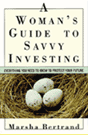
A Woman’s Guide to Savvy Investing


Everything You Need to Know to Protect Your Future

Women must know how to invest their own money! In today's world of down-sizing, divorce, and dubious social security benefits, there's a good chance that most women will have to take care of their own financial needs at some point in their (7-years-longer-than-men's) lives.

Where can women learn the basics of investing? From reluctant husbands, doubting boyfriends, or fast-talking stockbrokers? A more comfortable and informative way is from another woman! This frank, unintimidating book clearly explains everything a woman needs to know to invest wisely for her own secure future.

Readers learn:

The language of money (what all those terms mean)

What the basics are: stocks, bonds, mutual funds, dividends, capital gains (and losses)

Why and how companies issue stocks and how to benefit from their (positive) change in value

How to find a trustworthy stockbroker and avoid scams


The fundamentals of choosing stocks (so you're not dependent upon your uncle's “sure-thing tips”)

Analyzing a company's financial health, tracking its progress, knowing when to sell

Special investments: IPO's, investment clubs, short-selling, buying on margin, and socially-responsible investing.

By Marsha Bertrand

http://estore.amanet.org

10 Tips For Woman Before Using That Credit


The Dollar Diva's 10 timeless tips for women

Here are the top 10 things every woman should know about money:

1. Setting financial goals is the key to financial success.Write your goals down on paper. State the goal, when you want to get there and what you've got to do to make it happen. If you've always had trouble staying on a budget, try developing a spending plan.

2. Spending less than you earn is the secret to accumulating wealth. You can't have it all: choose a fancy lifestyle, and you choose paltry savings by default. If you'd like to become the millionaire next door live well below your means, and invest what's left over.

3.If you don't allocate time for managing your money, you won't have any money to manage. Money gets frittered away when it's not managed; take the time to track your cash. You can do it with a pencil and notebook, but it's a lot faster to do it with a software program such as Microsoft's Money or Intuit's Quicken. Many banks and credit card companies let you download transactions from their Web sites to your software program, making data entry a breeze. The four gauges you need to review each month are (1) what came in, (2) what went out, (3) what you own and (4) what you owe.

4. Education expands your mind and your earning potential. As a rule, education means a more interesting life and more money. Save some of that money, and you can buy yourself financial freedom. Education is your ticket to somewhere; don't leave life without it.

5. If you don't save when the chips are up, expect to drown in debt when the chips are down. Sooner or later you can count on being laid up, laid off or laid out. It happens to the best of us, and a stash of cash will cushion the blow. Without it, your lifeline will probably be high-interest debt that will linger long after the storm has passed.

6. You can't accumulate wealth if you charge more than you can afford to pay each month. High- interest credit card debt is highway robbery without the mask and gun. Motivate yourself to mop up your debt by using the Payment-push plan.

7. Choosing a fiscally irresponsible mate is hazardous to your financial health. Opposites tend to attract, and fiscally conservative gals tend to be drawn to fiscally liberal guys, and vice versa. If you're about to pair up with a big spender, don't sign for any debt you wouldn't be able to manage on your own. You and your partner should have a talk about any debt you have and how you will deal with it so you don't end up deeply in love and deeply in debt.

8. Shopping without a list costs more than shopping with one. Shopping smart will help you to live below your means. Everyone's familiar with the grocery list, and how it helps curtail impulse spending at the market. Try making a clothing list to keep you from the temptation of impulse shopping at the mall. Makes a list of what you must have in your wardrobe: number of shoes, blouses, suits, jeans, jackets and coats. Take an inventory of what you already have, and make a list of what you need to complete your wardrobe. That's your clothing-shopping list. Goodbye recreational shopping, hello increased savings.

9. Buying a car and keeping it until it dies is cheaper than leasing one. A car is wheels; don't give it more status than that. When she can't pay for it outright, the smart person saves up for the down payment, finances the car over 36 months, and enjoys many payment-free years in between cars. Educate yourself on the female car buyer's bill of rights.

10. Money buys financial freedom: go for it. Financial freedom is not gender limited: women can achieve it as well as men. For the latest and greatest ways to save and spend, sign up for Bankrate's free newsletters.

By Dorothy Rosen

http://www.bankrate.com/

The Right Multivitamin For Your Health


The Importance Of Multivitamin

Women, men, those over 50, those with chronic illness, and vegetarians have special needs to consider when choosing a multivitamin. Review your special needs below.

Why Everyone should Take a Multivitamin

There's nothing like a sound, low-fat diet full of fruits, vegetables, and whole grains to supply the vitamins and minerals we need to stay healthy. Unfortunately, we don't always eat well. Add to that the possible harmful effects of stress, aging, lack of exercise, pollution, and illness, and supplements become even more important. That's why so many experts now recommend that everyone take a daily multivitamin.

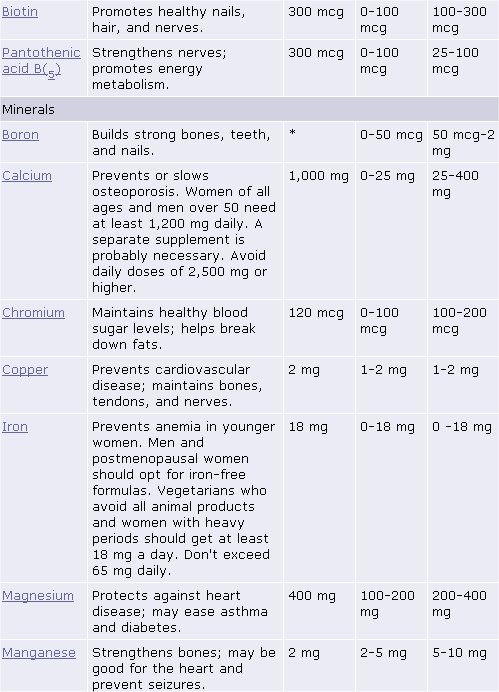
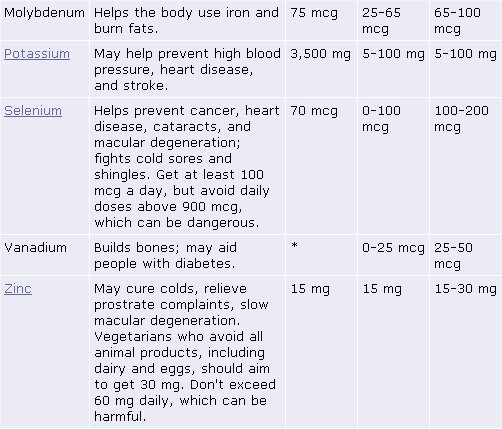
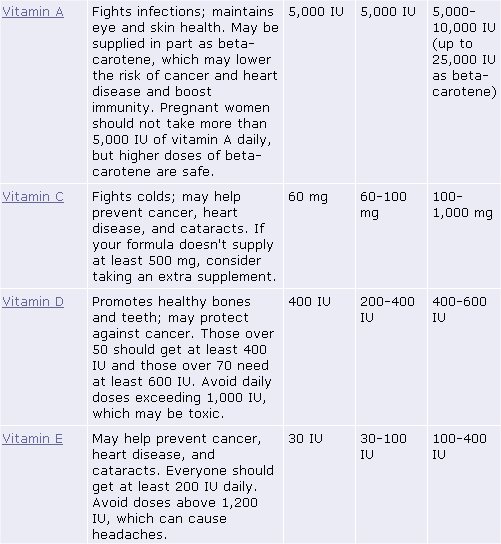
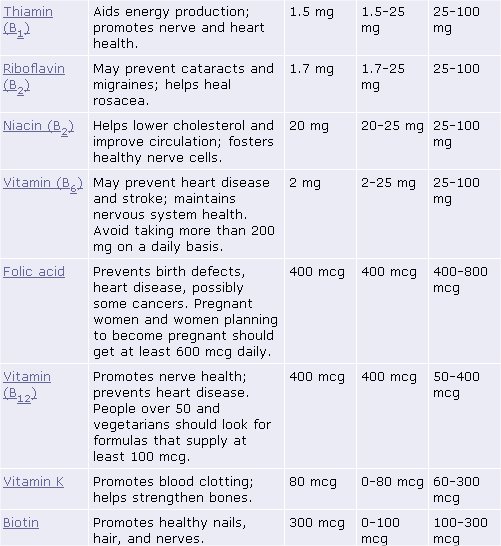
The Right Choice: See Our Multivitamin Chart

This chart outlines the key vitamins and minerals your multivitamin should supply and the main benefits of each nutrient. It also gives what's called the daily value (DV) - a new government standard that generally corresponds to the RDA. The DV satisfies minimum daily requirements and helps prevent a deficiency disease, such as scurvy (lack of vitamin C). The higher levels of vitamins and minerals found in many multivitamins may actually help prevent disease, delay its onset, or lessen the severity of certain ailments.

Good Reason to Take an extra-strength Formula

If you eat an optimal diet of low-fat foods, at least five servings of fruits and vegetables daily, and chicken, lean meat, or fish several times a week, you can probably get away with a once-daily formula. But even those who consume a fairly well-rounded diet and yield to junk-food lapses only occasionally can benefit from an extra-strength formula. If your idea of lunch is a slice of pizza and a diet soda, look for a multivitamin in the upper ranges of our chart.


Finding the Right Multivitamin for You


Special Needs

Women of all ages need at least 1,200 mg of calcium daily, through supplements or diet, to slow bone loss. Most multivitamins don't supply this much: A separate calcium supplement is probably your best bet. Younger women, especially those with heavy menstrual periods , need plenty of iron (18 mg a day ). Those considering pregnancy should get extra folic acid and avoid high-dose vitamin A. Special "women's formulas" may contain expensive herbs you may not need.

Men should avoid multivitamins containing iron: Iron build-up has been linked to heart disease. Be wary of "men's formulas that tout ingredients like saw palmetto for prostate complaints : Many of these high-profile "extras" are present in such small amounts that they provide little or no therapeutic benefit.

Over 50,opt for iron-free formulas: Too much of the mineral can cause heart problems. Look for vitamins B6 and B12 in the higher ranges, because as people age, they often have trouble absorbing these nutrients. Older women and men can benefit from the bone-strengthening effects of extra calcium (1,200 mg a day) and vitamin D (400 to 600 IU a day).

Chronic Illness can lead to poor eating habits or deplete nutrient stores. Extra-strength formulas are especially important if you suffer from a long-term digestive ailment or have liver or gallbladder problems. Consult your doctor before taking supplements.

Vegetarians who avoid all animal foods, including dairy and egg products, need at least 100 mcg daily of vitamin B12. Zinc, iron, and calcium are also very important minerals for strict vegetarians.

By wholehealthmd.com

http://www.wholehealthmd.com/

Monday, January 30, 2006

Choose The Health Foods For Lowering High Blood Pressure


High Blood Pressure Can Be Controlled

If you have elevated blood pressure, it is important to consume low-fat, low-sodium, high-fiber foods such as fruits and vegetables and plant foods. Flaxseed oil and foods high in potassium, calcium, magnesium, vitamin C, and omega-3 fatty acids, are all beneficial for people with high blood pressure. It is believed that vitamin C's ability to widen and relax blood vessels is connected to its blood pressure lowering capability. Garlic and onions have also been shown to reduce blood pressure due, possibly, to their sulfur containing compounds. Some studies have shown that substances found in celery subdue production of hormones that raise blood pressure.

Mega-Recipes

We believe that it's possible to manage and/or improve certain conditions through what you eat. When we create "Mega-Recipes" for an ailment, we strive to include the maximum number of the nutrients that are shown to have benefit for that ailment. We also expect the Mega-Recipe to contain at least 25% of recommended intakes for those nutrients. See the list of recipes that have met our criteria for this ailment.


What You Should Eat & Why

calcium

Increasing calcium intake appears to possess a greater blood pressure-lowering effect in hypertensive than normotensive individuals. Scientists are attempting to isolate the mechanism by which calcium appears to lowers blood pressure. Studies have shown that calcium may also reduce the risk of pregnancy-induced hypertension and preeclampsia. Leading Food Sources of calcium: Broccoli, Bok choy, Milk, Amaranth, Salmon, Kale, Beans, dried, Cheese, fresh, Tofu, Soybeans, Yogurt

flaxseed oil

Flaxseed oil may help protect against high blood pressure by inhibiting inflammatory reactions that cause artery-hardening plaque and poor circulation. Leading Food Sources of flaxseed oil: Oil, flaxseed

garlic

Several large double-blind clinical studies demonstrate that garlic significantly lowers blood pressure in people with hypertension. Leading Food Sources of garlic: Garlic
magnesium Foods high in magnesium may help to lower blood pressure. Magnesium plays a part in reducing elevated blood pressure by relaxing the muscles that control blood vessels, allowing blood to flow more freely. Leading Food Sources of magnesium:
Spinach, Avocados, Chocolate, Pumpkin seeds, Oysters, Sunflower seeds, Brazil nuts, Amaranth, Buckwheat, Almonds, Quinoa, Barley

omega-3

fatty acids Researchers theorize that omega-3 fatty acids foster good circulation due in part to their alpha-linolenic acid content. The presence of omega-3 fatty acids makes blood platelets less likely to clump together and form clots that lead to heart attacks. Leading Food Sources of omega-3 fatty acids: Salmon, Trout, Tuna

potassium

Potassium is an important dietary electrolyte that helps maintain blood pressure levels. Studies indicate that people who consume optimal amounts of foods high in potassium generally have lower blood pressure than those whose potassium intake is low. Leading Food Sources of potassium: Beets, Bok choy, Apricots, Pomegranates, Chocolate, Beans, dried, Clams, Oranges, Water chestnuts, Tomatoes, Potatoes, Quinoa, Cantaloupe, Bananas, Figs, Avocados, Yogurt, Broccoli, Brussels sprouts

vitamin C

Vitamin C may widen blood vessels, thus helping to lower blood pressure. Scientists speculate that constricted arteries may be partly caused by the type of cell damage that vitamin C corrects. Leading Food Sources of vitamin C: Cabbage, red, Peppers, bell, red, Tangerines & other mandarins, Oranges, Kiwi fruit, Strawberries, Potatoes

Mega-Recipes


California Pizza
Caribe Turkey Salad
Lasagna Arrabbiata
Roasted Salmon with Lentils & Lemon-Cilantro Dressing
Salmon on a Bed of Greens with Mango Salsa
Scalloped Salmon & Sweet Potatoes
Warm Lentil Salad with Goat Cheese
Roasted Garlic-Cheese Spread
Cranberry-Blueberry Smoothie
Triple-Gold Potato Salad
Vegetarian Chili with Bulghur
Tri-Berry Salad
Spiced Cream of Pumpkin Soup
Chicken Salad Niçoise
Orange-Mint Carrots
Artichokes with Creamy Lemon-Garlic Sauce
Apricot-Studded Pilaf with Mushrooms
Hoppin' John with Shiitakes
Potato Pancakes with Yogurt-Dill Topping
Mushroom, Root Vegetable & Barley Soup
Nectarine-Pineapple Chutney
Cheese-Stuffed Baked Sole

By wholehealthmd.com

http://www.wholehealthmd.com/

Hypertension (High Blood Pressure) Can Affects Your Health


It's Important To Know About High Blood Pressure

High Blood Pressure, also called hypertension, is a risk factor for heart and kidney diseases and stroke. This means that having high blood pressure increases your chance (or risk) of getting heart or kidney disease, or of having a stroke. This is serious business: heart disease is the number one killer in the United States, and stroke is the third most common cause of death.

About one in every four American adults has high blood pressure. High blood pressure is especially dangerous because it often gives no warning signs or symptoms. Fortunately, though, you can find out if you have high blood pressure by having your blood pressure checked regularly. If it is high, you can take steps to lower it. Just as important, if your blood pressure is normal, you can learn how to keep it from becoming high.

What Is Blood Pressure — And What Happens When It is High?

Since blood is carried from the heart to all of your body's tissue and organs in vessels called arteries, blood pressure is the force of the blood pushing against the walls of those arteries. In fact, each time the heart beats (about 60-70 times a minute at rest), it pumps out blood into the arteries. Your blood pressure is at its greatest when the heart contracts and is pumping the blood. This is called systolic pressure. When the heart is at rest, in between beats, your blood pressure falls. This is the diastolic pressure.


Blood pressure is always given as these two numbers, systolic and diastolic pressures. Both are important. Usually they are written one above or before the other, such as 120/80 mm Hg, with the top number the systolic, and the bottom the diastolic. Different actions make your blood pressure go up or down. For example, if you run for a bus, your blood pressure goes up. When you sleep at night, your blood pressure goes down. These changes in blood pressure are normal.

Some people have blood pressure that stays up all or most of the time. Their blood pushes against the walls of their arteries with higher-than-normal force. If untreated this can lead to serious medical problems like these:

Arteriosclerosis("hardening of the arteries"). High blood pressure harms the arteries by making them thick and stiff. This speeds the build up of cholesterol and fats in the blood vessels like rust in a pipe, which prevents the blood from flowing through the body, and in time can lead to a heart attack or stroke.

Heart Attack. Blood carries oxygen to the body. When the arteries that bring blood to the heart muscle become blocked, the heart cannot get enough oxygen. Reduced blood flow can cause chest pain (angina). Eventually, the flow may be stopped completely, causing a heart attack.

Enlarged heart. High blood pressure causes the heart to work harder. Over time, this causes the heart to thicken and stretch. Eventually the heart fails to function normally causing fluids to back up into the lungs. Controlling high blood pressure can prevent this from happening.

Kidney Damage. The kidney acts as a filter to rid the body of wastes. Over a number of years, high blood pressure can narrow and thicken the blood vessels of the kidney. The kidney filters less fluid, and waste builds up in the blood. The kidneys may fail altogether. When this happens, medical treatment (dialysis) or a kidney transplant may be needed.

Stroke. High blood pressure can harm the arteries, causing them to narrow faster. So, less blood can get to the brain. If a blood clot blocks one of the narrowed arteries, a stroke (thrombotic stroke) may occur. A stroke can also occur when very high pressure causes a break in a weakened blood vessel in the brain (hemorrhagic stroke).

By fmgturlock.com

http://www.fmgturlock.com/

Different Types Of Incomes


There are three types of income:


EARNED INCOME

This includes income derived, generally, from a job or some form or labor. In its most common form, it is income from a paycheck. It is also the highest-taxed income, so it is the hardest income with which to build wealth. When you say to a child, "Get a good job" you are advising them to work for earned income.

PASSIVE INCOME

This is income that is, generally, derived from real estate. It can also be income derived from royalties from patents or license agreements. In approximately 80% of passive income scenarios, the income is from real estate. There are many tax advantages afforded with real estate investments.

PORTFOLIO INCOME

This income is generally derived from paper assets such as stocks, bonds and mutual funds. Portfolio income is, by far, the most popular form of investment income simply because paper assets are so much easier to manage and maintain than other types of investments.

By Robert T. Kiyosaki

http://www.richdad.com/

Understanding The B-I Triangle Allows A Person To Create An Asset That Buys Other Assets


What Is The B-I Triangle?

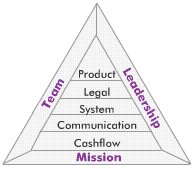
The B-I Triangle, as a whole, represents a strong system of systems – supported by a team with a leader – all working with a common mission toward common goals.

If one member of the team is weak or falters, the overall success of the business can be jeopardized. The B-I Triangle represents the knowledge required to be successful in the B and I quadrants on the right side of the CASHFLOW Quadrant.

Three important points in summarizing the B-I Triangle:

Money always follows management. If any of the management functions of the five individual levels are weak, the company will be weak. Once you identify your weakness, you may then want to consider turning it into your strength or hiring someone with that strength.

Some of the best investments and businesses are the ones you walk away from. If any of the five levels are weak and the management is not prepared to Strengthen them, it is best to walk away from the investment.

Technology has leveled the playing field. The personal computer and the Internet have made the principles and applications of the B-I Triangle more available, affordable, and manageable for everyone. When a business fails, it is often due to failure in one or more sectors of the B-I Triangle. The B-I Triangle gives structure to your ideas. It represents the knowledge required to be successful in the B and I quadrants on the right side of the CASHFLOW Quadrant.

By Robert T. Kiyosaki

http://www.richdad.com/

Understanding The difference Between Assets & Liabilities


Assets vs. Liabilities


Assets - something that puts money into your pocket

Liabilities - something that takes money out of your pocket


Is the home in which you live an asset or a liability?

In Rich Dad's world, your house is a liability. Even if you own the property with no mortgage, you still pay property taxes, utilities, maintenance, etc. Therefore: money is being taken out of your pocket. It is not until you sell that property – at a profit and realize capital gains – that it becomes an asset.

Types of Asset Classes

There are three types of assets:

PAPER ASSETS

This includes stocks, bonds, mutual funds, insurance

They create
PORTFOLIO INCOME

REAL ESTATE

This includes residential properties you don't live in and commercial properties

They create
PASSIVE INCOME

BUSINESSES

They create
PASSIVE INCOME

By Robert T. Kiyosaki

http://www.richdad.com/

Cashflow Quadrant


Understanding The Cashflow Quadrant

The CASHFLOW Quadrant describes the four different types of people represented in the world of business: the employee, the self-employed, the business owner and the investor.

E - Employee
S- Self-Employed
B - Business Owner
I – Investor

Employees (E) and self-employed individuals reside on the left side of the CASHFLOW Quadrant. The right side of the Quadrant is for individuals who receive their income from businesses (B) they own or investments (I) the have/make/own.

Each of us resides in at least one of the four quadrants of the CASHFLOW Quadrant. Where we fall within the quadrant is determined by what types of efforts generate our income. What quadrant – or quadrants – generate your income?


By Robert T. Kiyosaki

http://www.richdad.com/

Having Time on Your Side


Time Can help You Cut Down Your Risk

Even after the bear market of 2000-2002, the stock market has returned, on average, about 12% per year since World War II. That's for a portfolio that is one-half large company stocks and one-half small company stocks (using the data from Ibbotson Associates, an industry leader in compiling market statistics). This assumes all dividends were reinvested and ignores the unfortunate fact that in real life Uncle Sam steps in and confiscates a hefty portion of your gains.

Of course, knowing the market's average return has been 12% annually doesn't tell you what the return will be this year. Such an average obscures some pretty wild rides along the way (such as twelve-month periods where losses were as horrifying as 36% and gains were as breathtaking as 79%). In fact, only about 4% of the time have stocks actually returned 12% (give or take 1%) in a twelve-month period.

What it does tell you, however, is that time is on the side of the long-term investor. The longer you are willing to keep your money in the stock market, the greater your likelihood of success. According to the Ibboston data, if you picked any 12-month period at random since World War II to own stocks, you had a 78% chance of making money. How much money? Study the historical evidence in the table. You would have had about a 39% probability of making 20% or more, a 22% chance of making 10%-20%, and a 17% chance of earning 1%-10%.

The numbers presented here are based on "rolling" periods. After looking at the results from holding periods that began on January 1, I then "rolled" to the next month to see what happened if the holding period had begun on February 1. And so on through the year. This gives a better understanding of the extremes you might expect.

Notice that only 9% of the three-year holding periods lost money. In other words, if you held your stocks for at least three years, you raised your likelihood of making money to 91%! You can see that as the holding period increases, the very large gains and losses gradually disappear as the market moves closer to its long-term historical average. More importantly, by the time you reach a four-year holding period, any losses you experience are likely to be minor. After eight years, the losses have stopped altogether.

How can you apply this? By aligning your investment expectations accordingly. Begin judging your investment progress in terms of the market's long-term average annual return and how much time remains before you will need to sell your holdings. It may be that, on occasion, your mutual fund portfolio will show far greater growth than 12% annually (as it did last year). Don't expect this to continue indefinitely. Recognize it for what it is — one of those above-the-norm results. Your additional profits will provide you with a cushion in case the market is not as kind to you this year.

On the other hand, if you finish this year ahead only +4%, don't despair. You would temporarily be "behind schedule" with respect to your 12% goal, but as long as you still have many years remaining in your expected holding period, you still have the odds in your favor. You should hang in there and wait for the stock market to do what it has always done in the past — reward the patient investor.

In closing, let me say that investors should take on the higher risks of owning stocks only because they need the higher returns they offer. My advice is that you not take on any more risk than necessary, that is, that you invest at the lowest level of stock exposure consistent with achieving your growth and income goals.

By Austin Pryor

http://www.soundmindinvesting.com/

Sunday, January 29, 2006

Tighten Your Hamstring Muscles With These Simple Exercises


Leg Lift

Exercise Data

Main Muscle Worked: Glutes

Other Muscles Worked: Hamstrings

Equipment: BodyOnly

Mechanics Type: Isolation

Video Guide:
Windows Media - MPEG

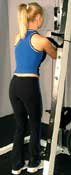
Tips: Grabbing the top of a chair back to brace yourself, stand up straight, lift one leg behind you while keeping the other leg straight. Bring the raised leg back to the floor and raise it again for 10 repetitions. Then do the same for the other leg. Concentrate on flexing the glutes to that you feel them do the work. This should begin to tighten and firm these muscles.


One-Legged Cable Kickback

Exercise Data

Main Muscle Worked: Glutes

Other Muscles Worked: Hamstrings

Equipment: Cable

Mechanics Type: Isolation

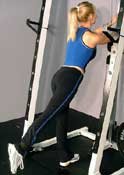
Tips: The one-legged cable kickback is a great way to carve shape into those sagging buns. Hook a leather ankle cuff to a low cable pulley and then attach the cuff to your ankle. Face the weight stack from a distance of about two feet, grasping the steel frame for support. While keeping your knees and hips bent slightly and your abs tight, contract your glutes to slowly "kick" the working leg back in a semicircular arc as high as it will comfortably go. At full extension, squeeze your glutes for peak contraction. Bring your working leg forward, resisting the pull of the cable until you reach the starting position. After completing the desired number of reps, switch legs and repeat this movement for the other bun.

By bodybuilding.com

http://www.bodybuilding.com/
Shape Your Butt With Exercises For The Glutes


Butt Lift (Bridge)

Exercise Data

Main Muscle Worked: Glutes

Other Muscles Worked: None

Equipment: BodyOnly

Mechanics Type: Isolation

Video Guide:

Windows Media - Real Player

Tips: Lying on your back with your knees bent, lift your hips off the floor while keeping your back straight. Remember to keep your glutes tight!


Glute Kickback

Exercise Data

Main Muscle Worked: Glutes

Other Muscles Worked: Hamstrings

Equipment: BodyOnly

Mechanics Type: Compound

Video Guide: Windows Media - Real Player

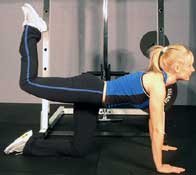
Tips: While on the floor on all fours, extend one leg and with the foot cocked to a point that places it in line with the head. Then raise it to a 45-degree angle with the foot elevated above the head. The key to maximum results is to concentrate on contracting the glutes throughout the full range of motion.

By bodybuilding.com

http://www.bodybuilding.com/
Victims of a Toxic Colon


Have you ever considered this simple question: Are you clean inside?

We shower, brush our teeth and wash our hair on a daily basis, but we tend to ignore cleansing our insides until some form of disease sends us a wake-up call. Believe it or not, our insides, especially the colon which functions as the “sewer system” of our body, also requires regular cleaning. Constipation, parasites, IBS, gas, bloating, stomach pain, chronic fatigue, digestive problems can all be signs of a toxic colon. Don’t be a victim, suffering silently from these painful and often embarrassing health conditions. Find out the truth about colon cleansing and how it can help you.

Why Is Colon Cleansing So Crucial?

We are all exposed to thousands of toxins and chemicals on a daily basis at work, in the home, through the air we breathe, our food and water supply, and through the use of pharmaceutical drugs. In addition, we are eating more sugar and processed foods than ever before in human history and regularly abuse our bodies with various stimulants and sedatives.

"Death Begins in the Colon"

These toxins and “dead” foods lead to poor digestion, constipation, toxic colon build-up, weight gain and low energy. These common symptoms are more than just an inconvenience – they can lead to long-term health problems and serious disease.

“Of all the polite topics of conversation, the state of one's intestines is probably at the bottom of most people's lists. Let's face it: Irritable bowel syndrome, constipation, gas, diverticulitis and colon cancer are simply not things we like to discuss. And yet, as the old expression goes, death begins in the colon. Don't believe it? Ask any coroner. Autopsies often reveal colons that are plugged up to 80 percent with waste material.” – Vegetarian Times, March, 1998

“Every living thing has at least one parasite that lives inside or on it, and many, including humans, have far more. …Scientists…are only just beginning to discover exactly how powerful these hidden inhabitants can be, but their research is pointing to a remarkable possibility: Parasites may rule the world. The notion that tiny creatures we've largely taken for granted are such a dominant force is immensely disturbing. … We are collections of cells that work together, kept harmonized by chemical signals. If an organism can control those signals — an organism like a parasite — then it can control us. And therein lies the peculiar and precise horror of parasites.”

The combination of environmental toxins, an unhealthy diet and parasites poses a grave danger to humans. “In fact, parasites have killed more humans than all the wars in history”, reported National Geographic in its award-winning documentary, The Body Snatchers.

By drnatura.com

http://www.drnatura.com/

Helps Break Down Fats And Carbohydrates!


Let Your Body Absorb The Nutrients

You aren't what you eat, but what you absorb! Digestive enzymes break down carbohydrates, proteins, fats, and other substances in your small intestine so your body can absorb and use all the nutrients you feed it.

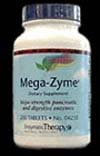
Mega-Zyme provides the highest potency enzyme complex available to break down fats and carbohydrates in the small intestine. They're combined with a wealth of protein-digesting enzymes in a special bicarbonate complex.

Give your hard-working digestive system a break with Mega-Zyme.

Mega-Zyme

* Nutritionally supports the digestive system

* Provides the highest potency pancreatic enzyme complex

* Includes a wealth of protein-digesting enzymes

While other pancreatin products are often diluted with salt or lactose, Mega-Zyme contains full-strength, undiluted pancreatic extract for optimum natural advantages. Mega-Zyme is a unique supplement formula for those who wish to support their diet with natural proteolytic enzymes from both plant and animal sources.

What's In It?

Supplement Facts:

Container Size: 100 Tablets
Serving Size: 2 Tablets
Servings Per Container: 50

Container Size: 200 Tablets
Serving Size: 2 Tablets
Servings Per Container: 100

Amount Per Serving:

Pancreatic Enzymes 10x 325mg

USP Units of Activity:
Protease 81,250
Amylase 81,250
Lipase 6,500
Trypsin 75mg
Papain 50mg
Bromelain 50mg
Amylase 10mg
Lipase 10mg
Lysozyme 10mg
Chymotrypsin 2mg

Other Ingredients:Cellulose, Potassium Bicarbonate, Modified Cellulose Gum, Modified Cellulose, Magnesium Stearate, lecithin, and Carnauba Wax.

Directions: Take 2 Tablets before each meal.

By Bodybuilding.com

http://www.bodybuilding.com/